
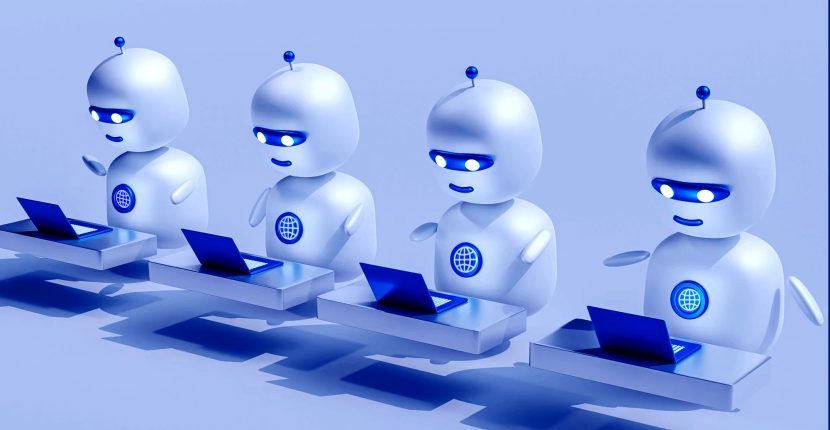
The Internet is (increasingly) becoming non-human
What happens when the Internet gradually stops being a place where we primarily interact with others?
SUMMARY
Content delivery network and cloud cybersecurity company Cloudfare reports that “50% of traffic on the Internet is now non-human.” So what does non-human mean? And what are the cyberpsychological implications of an Internet that’s increasingly becoming ‘invisible?’
INTERNET traffic is now half bot, half human.
Once upon a browser time, the Internet was a place where we searched, clicked, explored, compared, argued, commented, bookmarked, linked, and discovered.
Today, Cloudfare’s Agentic Internet Bot Report indicates half of all that activity is bot-originating.
How does a decreasingly human Internet impact our sense of digital experiences online?
And If human browsing keeps declining this dramatically, then will important forms of digital social participation also decline?
let’s UNPACK THESE implications.
But first, it’s important to understand what is causing an acceleration of non-human (aka bot-based) traffic online.
The answer, according to Cloudfare, is “Google Zero.”
Google Zero is what publishers refer to as zero search traffic from Google. But let’s be clear; the traffic most publishers care about is human, not bot-based search traffic.
At the crux of this steady decline appears to be Google’s AI Overviews, which are often AI-generated summaries about a user’s specific search query placed directly above (organic) search results (and above the fold). Publishers complain that these AI summaries discourage a user’s click-based exploration to links placed below the summaries. In turn, this discouragement of human browsing activity is what is being blamed for some of the decline of the human Internet.
Now to the unpacking:
If there is a decline in human search traffic online, one could argue there may be an important correlation to a decline in human browsing overall.
When human browsing and other Internet-related behaviors (such as clicking, exploring, and the like) decline dramatically, then one could also argue that an important form of social participation across digital spaces also declines.
CYBERPSYCHOLOGICAL IMPACTS OF An increasingly “machine” internet
Cyberpsychology focuses on human behavior in the context of digital environments so the Internet ecosystem, and our behavior online, falls nicely into this field of scientific study.
With the rise of a machine, rather than a human, Internet, anticipated impacts to human behavior online might include:
- Intellectual and curiousity-fueled searches (that resulted in a litany of organic, human clicks to publisher sites) will continue to decline.
This is because AI Overviews collapse user exploration into one synthesized answer and this advantageously placed, high convenience summary feature discourages the spontaneous browsing activity the Internet of the past was known to inspire. - The way we experience information is changing.
Before, it was all about searching for information across Internet blogs or websites. Today’s users increasingly experience information without experiencing where the information lives. For example, users use AI chatbots to search; instead of searching on a search engine, users “search” using Claude, ChatGPT, Copilot, Gemini, or Perplexity. In other words, AI now mediates informational search activity. - Humans may no longer occupy the Internet’s central role.
The Internet was primarily a human social environment and the machines underpinning it were largely invisible infrastructure. But as machines rise to primary participant status on the Internet, then humans become indirect or secondary participants.
So what does any of this mean … especially the last bullet point above?
THE ANSWER IS TBD (TO BE DETERMINED).
For thirty years, we humans have navigated the web. But now, it appears AI can navigate the web for us.
This tremendous shift is happening in real-time and the effects are only just unfolding so it’s an arena we’ll surely watch to understand how human behavior changes along with these AI-impacting trends.
One thing that *is* certain is this:
As people shift from performing cognitive work themselves to directing (AI) systems that perform the work on their behalf, profound changes to human behavior online will be afoot.
By the way, these ideas presented forward in this post the very reasons why the field of AI psychology is rapidly rising; but I’ll write more about this topic in a future post.
Interesting times indeed!

Mayra Ruiz-McPherson, PhD(c), MA, MFA
Founder & Psychological Futurist
The CyberPsych Institute
Empowering Minds for the AI Age
REFERENCES
Weiss, A., Albertson, Z., & Lanfear, E. (2026, July 1). Content Independence Day, one year on: Building the business model for the agentic Internet. Cloudflare Blog. https://blog.cloudflare.com/agentic-internet-bot-report.